Below the Surface: Re-storying the Mermaid of Marden is an art project centred on a Herefordshire myth about a mermaid who stole the local church bell. Through print, sound, installation and conversation, the project aims to invite visitors to engage with the myth and its themes in accessible ways. .
The Mermaid of Marden
Folklore
In line with my current practice and to establish a connection with the landscape surrounding Presteigne, I looked to the area's folklore. One tale kept appearing in my searches, a tale of a mermaid who dwelt in the river Lugg beside the church in Marden. Although the village is some twenty-two miles from Presteigne, never having heard of a freshwater mermaid I was intrigued, and researched further.
The Marden Mermaid is a little-known Herefordshire story, passed down and eventually documented by the acclaimed folklorist and song collector Ella Mary Leather (1874-1928). Leather published her highly regarded and authoritative work, Folklore of Herefordshire, in 1912. The story as published:
The Mermaid of Marden.
In former times Marden church stood close to the river, and by some mischance one of the bells was allowed to fall into it. It was immediately seized by a mermaid, who carried it to the bottom and held it there so fast that any number of horses could not move it.
The people of the parish were told how to recover it, by wise men, according to some; others say the bell itself gave directions from the bottom of the river. A team of twelve white freemartins, i.e., heifers, was to be obtained and attached to the bell with yokes of the sacred yew tree and bands of “wittern”1 or, in some versions, the drivers’ goads were to be of witty or wittern (mountain ash).
The bell was to be drawn out in perfect silence; it was successfully raised to the edge of the river with the mermaid inside fast asleep. In his excitement a driver, forgetting that silence was all-important, called out:-
“In spite of the devils in hell
Now, we’ll land Marden’s great bell”
This woke the mermaid, who darted back into the river, taking the bell with her ringing:-
“If it has not been
For your wittern bands (or witty goads),
And your yew tree pin,
I’d have had you twelve free-martins in.”
So Marden folks have never had their bell back from the bottom of the river to this day, and sometimes it may still be heard ringing, echoing the bells of the church. It does in a deep clear pool.2
Leather’s postscript.
In 1848, in cleaning out a pond at Marden, an ancient bronze bell was discovered. It lay at a depth of eighteen feet, beneath the accumulated mud and rubbish of centuries. This bell, which is now in Hereford Museum, is rectangular in shape; the plates are riveted together on each side. The clapper is lost, but there remains the loop inside from which it was suspended.
1 Rowan or mountain ash is especially potent against witchcraft, and in this case, a mermaid’s power.
2 The story of the mermaid was communicated to Leather by one Mr Galliers of King’s Pyon.
The Marden Bell
My next step was to see if I could view the Marden Bell. I contacted the archives team at Hereford Museum and scheduled an appointment to view it. Normally, the bell is on display to the public, but the museum is currently being transformed into the new Hereford Museum and Art Gallery, opening in 2027. Luckily, as a significant artefact, it is often loaned to other museums and galleries and was currently being held at the History Store in Hereford.
The archives team could not have been more helpful. It was such a privilege not only to be in the presence of the physical bell but also to meet Collections and Engagement Curators, Emalee Beddoes and Ben Moule. They talked at length and with great knowledge about the Bell, its history and Ella Mary Leather’s version of the tale.
I do not possess the gift of Psychometry - also known as object reading, but I am able to read the energy of a space, place or room. In this instance, I was taken aback by the humble presentation of this ‘sacred’ bell. It did not try to dazzle or influence me through its material richness. No. The bell was as grounded and solid as a standing stone, and yet when I view it, I sense its lightness, being swung easily, gaining momentum, ringing out. Or perhaps even struck with a wooden baton to produce a deep, sonorous toll. There is evidence of a clapper within the bell, but having most likely been made of wood, it has perished long since. I am reliant on others' knowledge of the actual sound these bells make.
The Bells construction appears quite simple at first glance, but I only grasped its design complexities when attempting to create a replica. The images below reveal that the bell curve is three-dimensional. I was only cutting my replica from card; imagine the challenge of forging it from a single sheet of iron. The handle's design is also intricate—deceptively simple, curving in all directions. Forming the ‘D’ shape without cracking at the corners demonstrates exceptional skill.
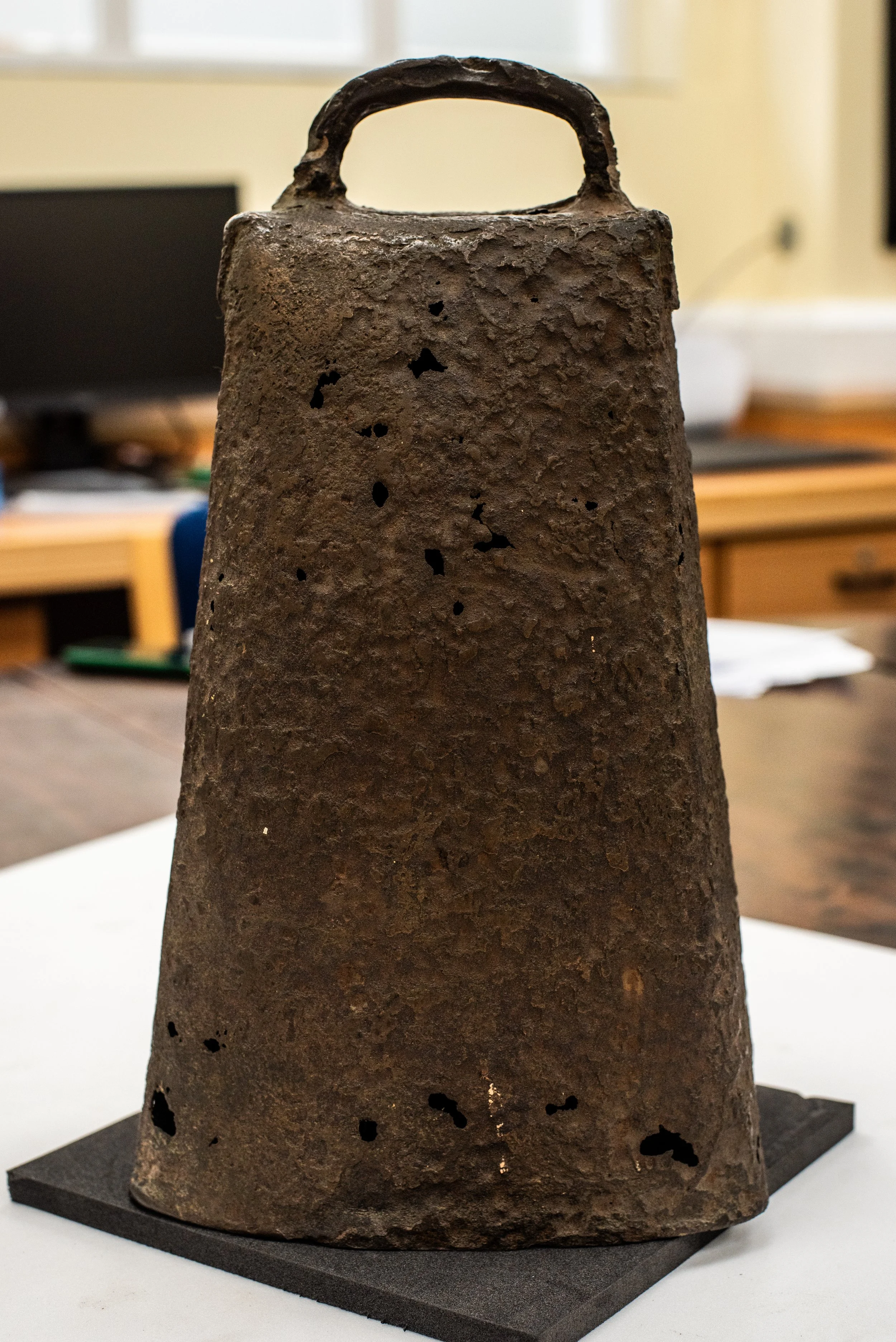
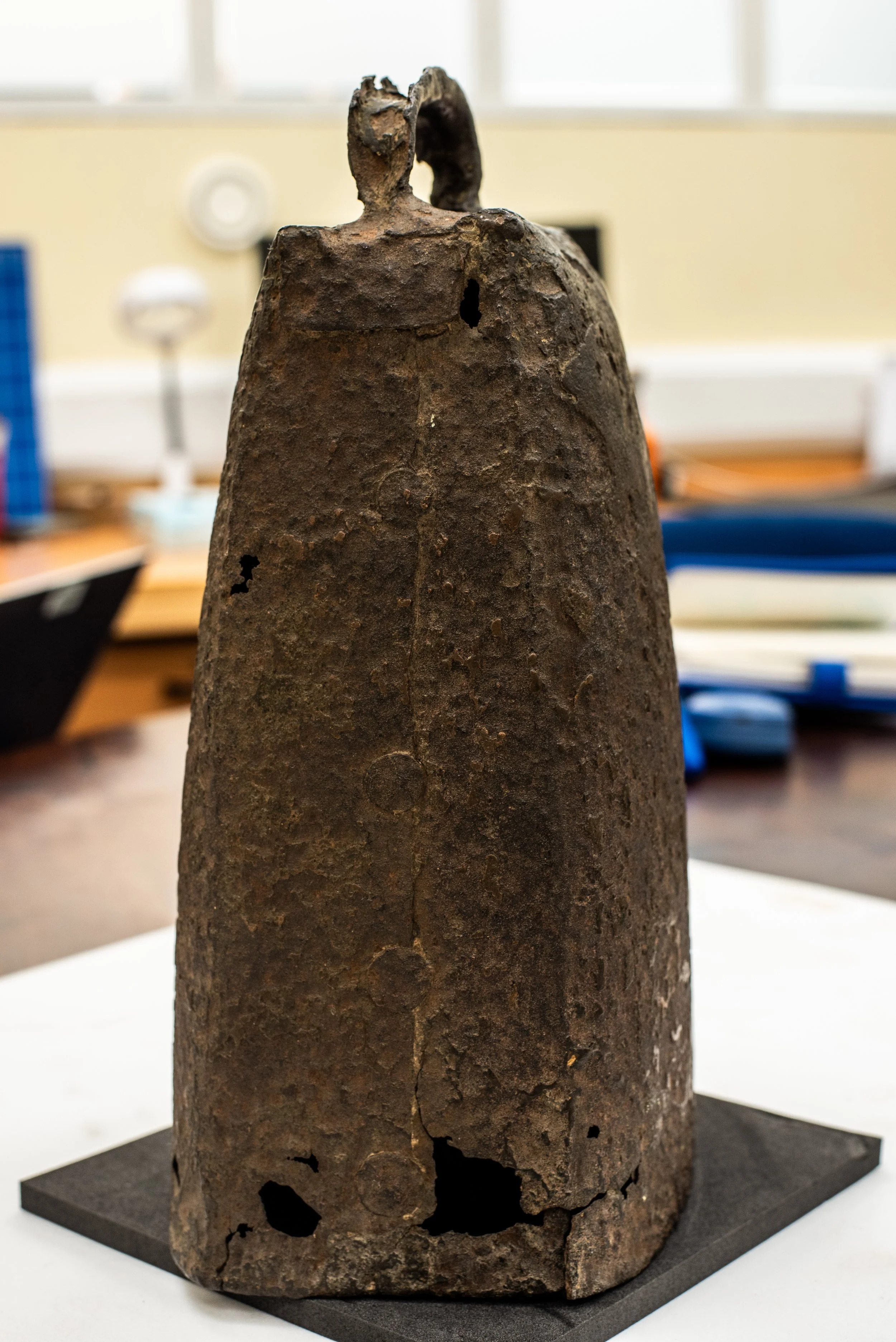
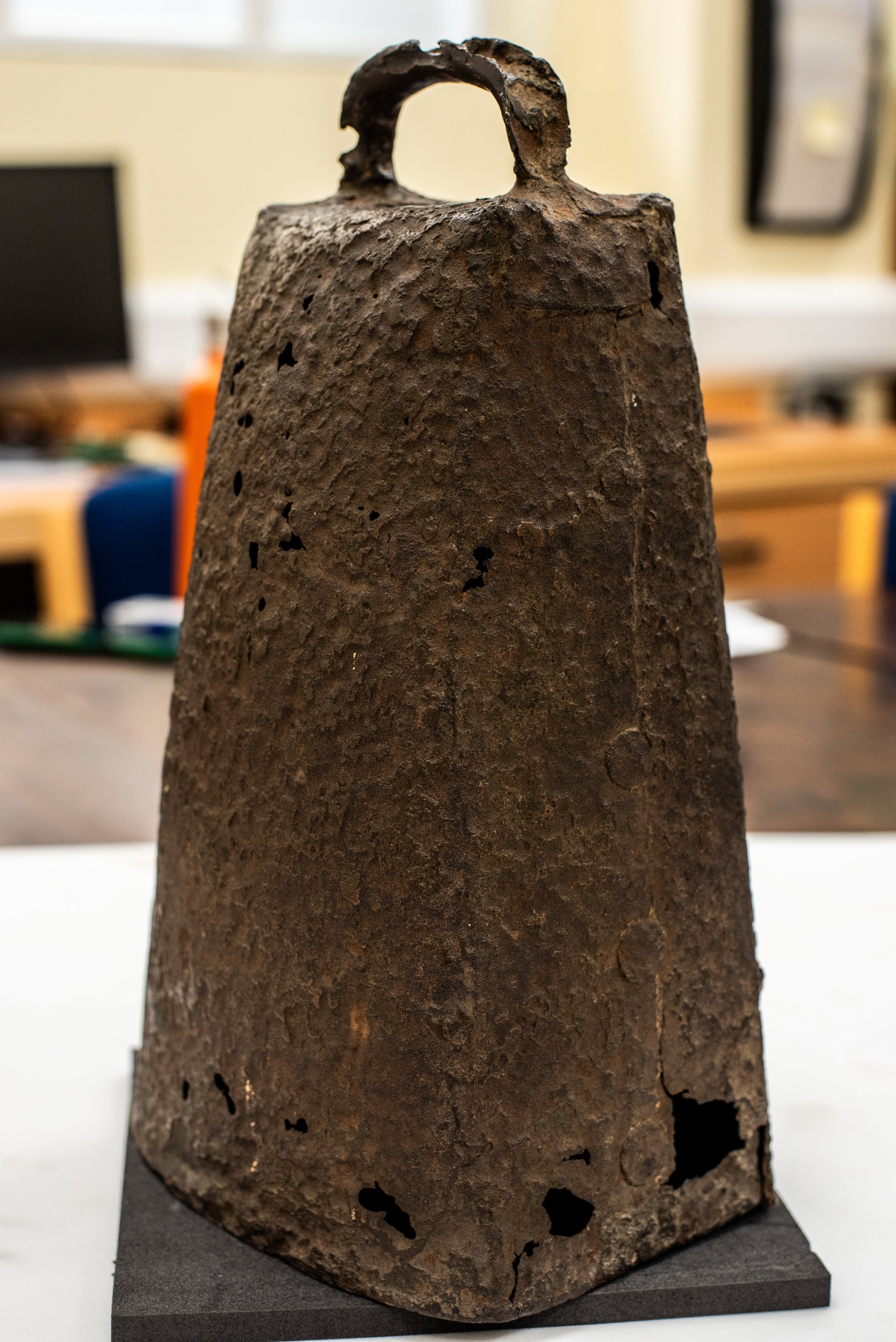
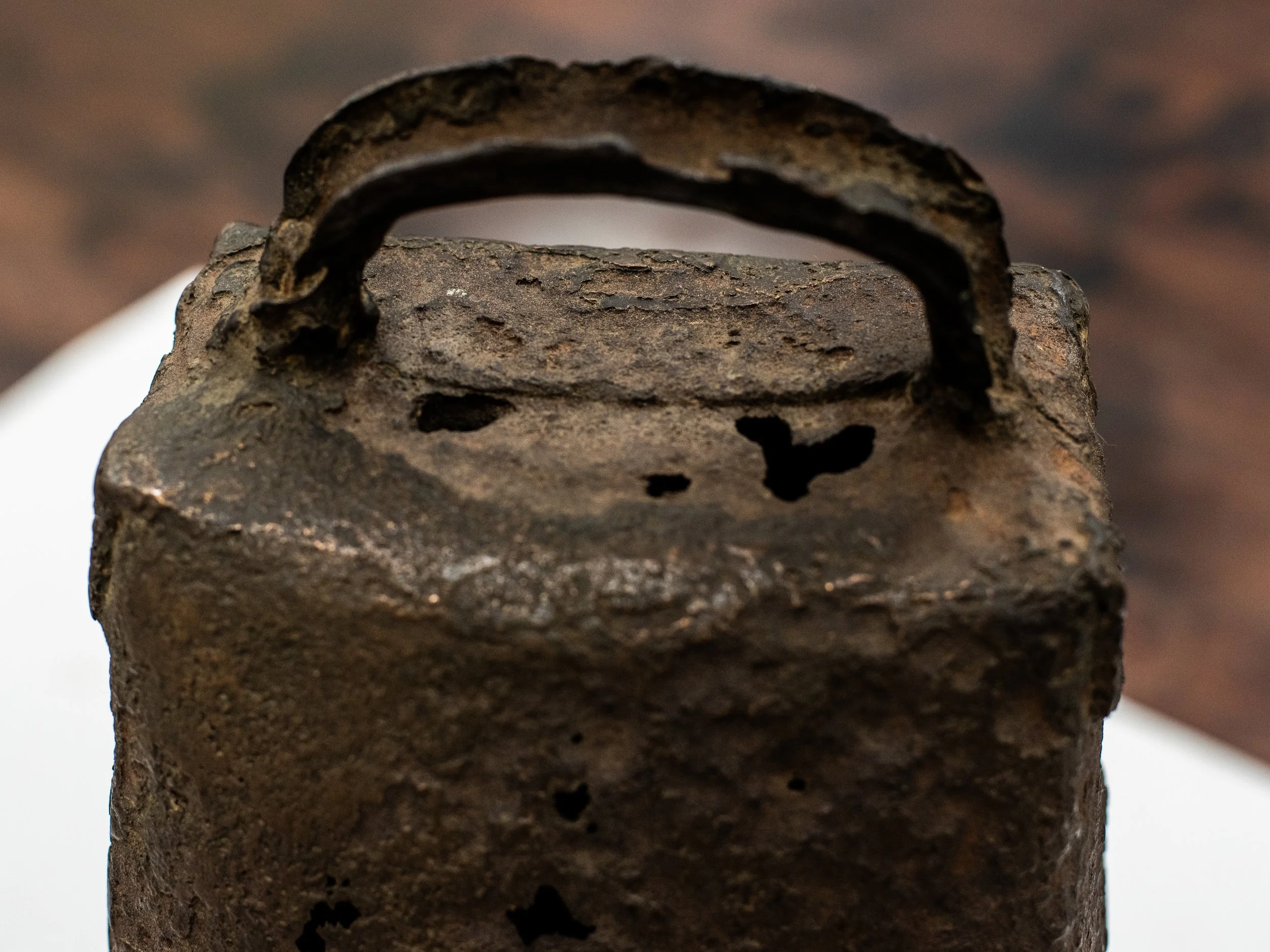
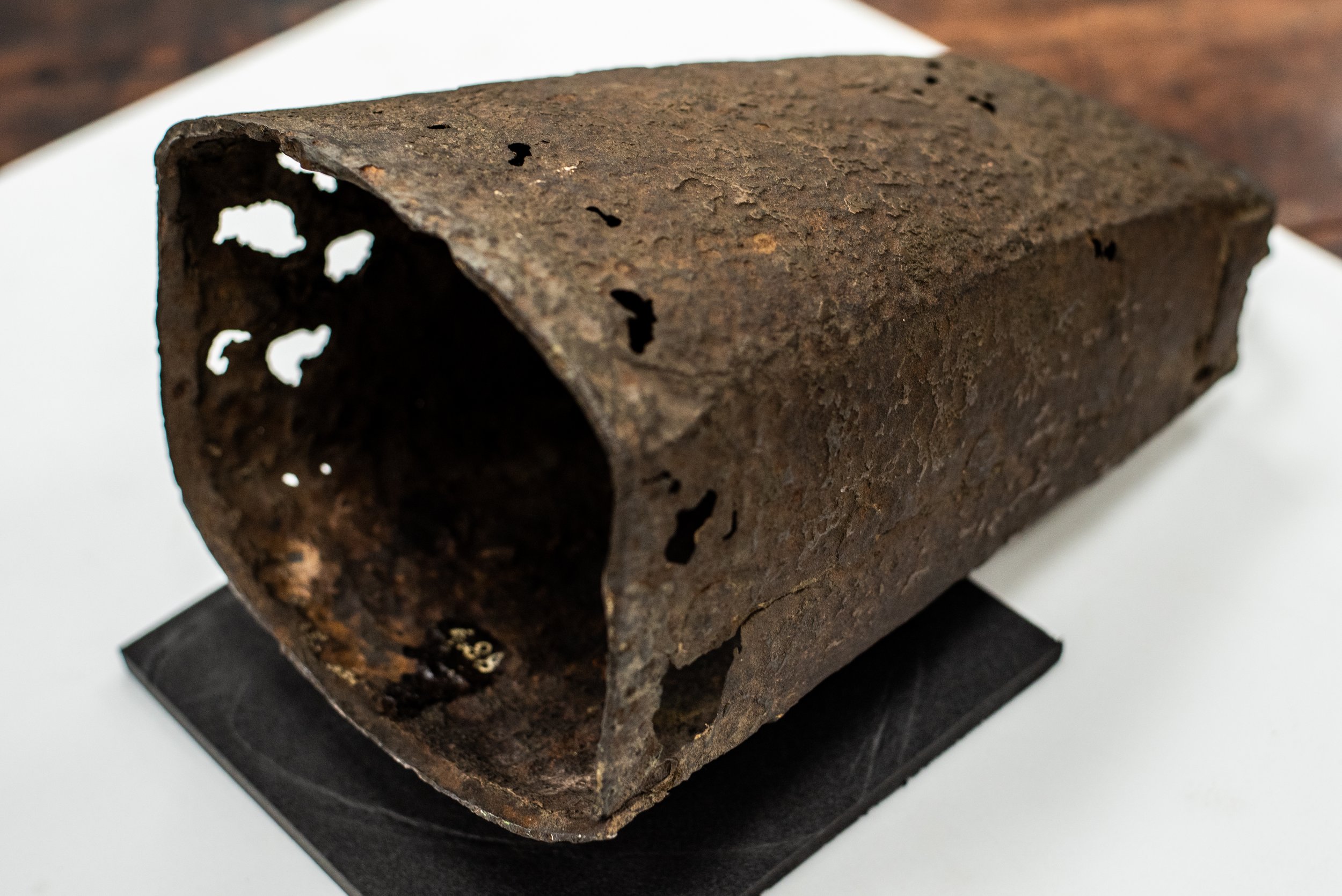
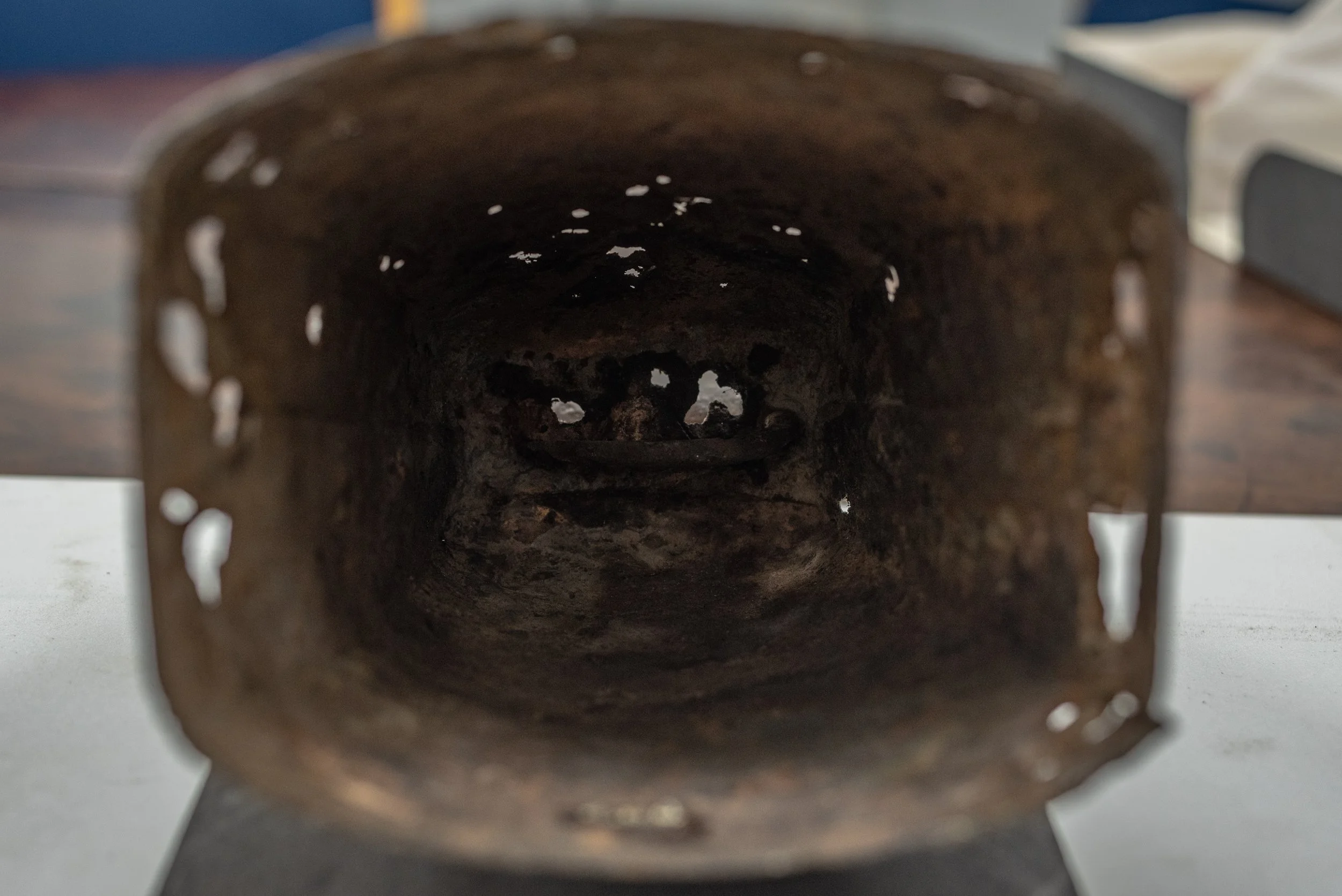
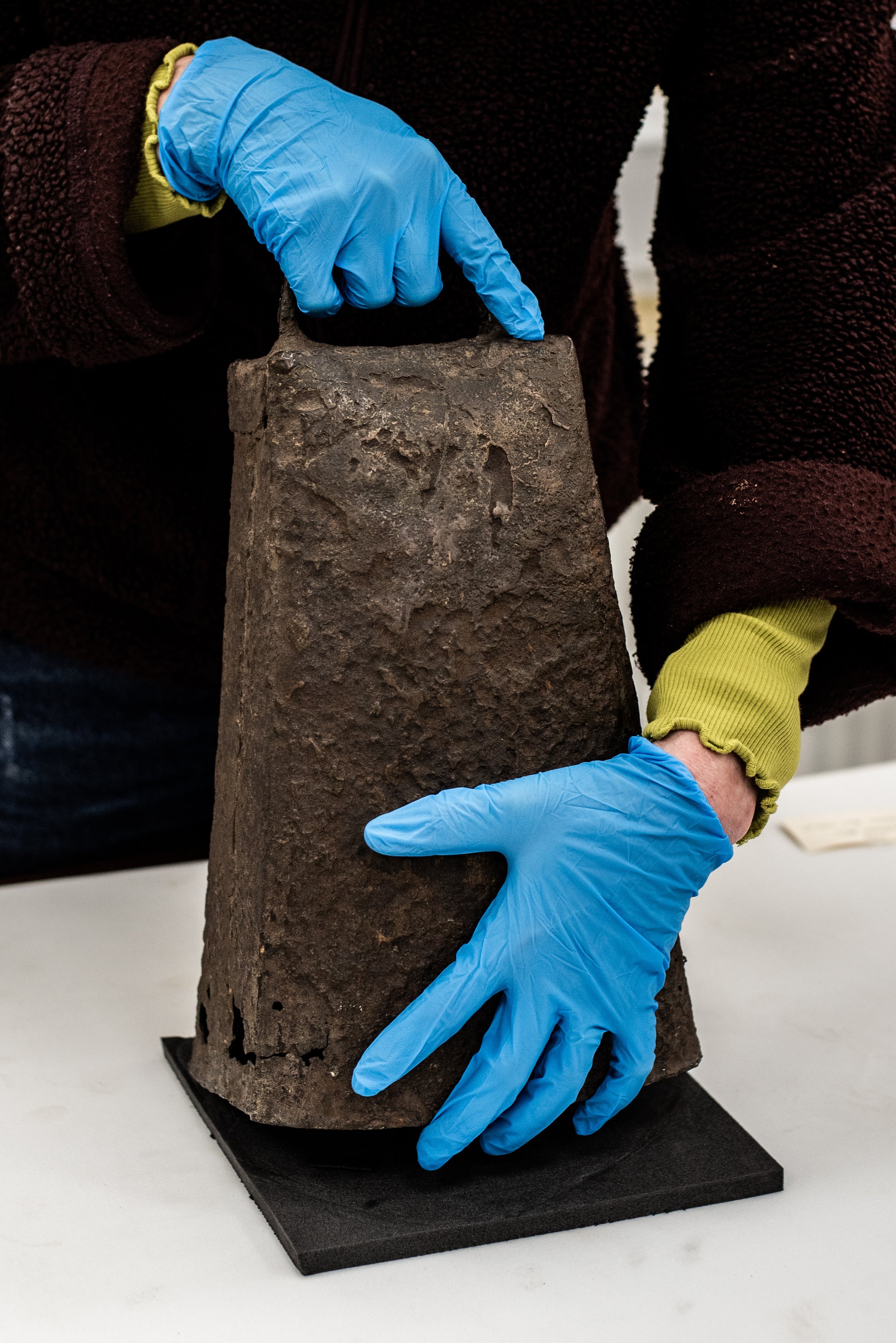
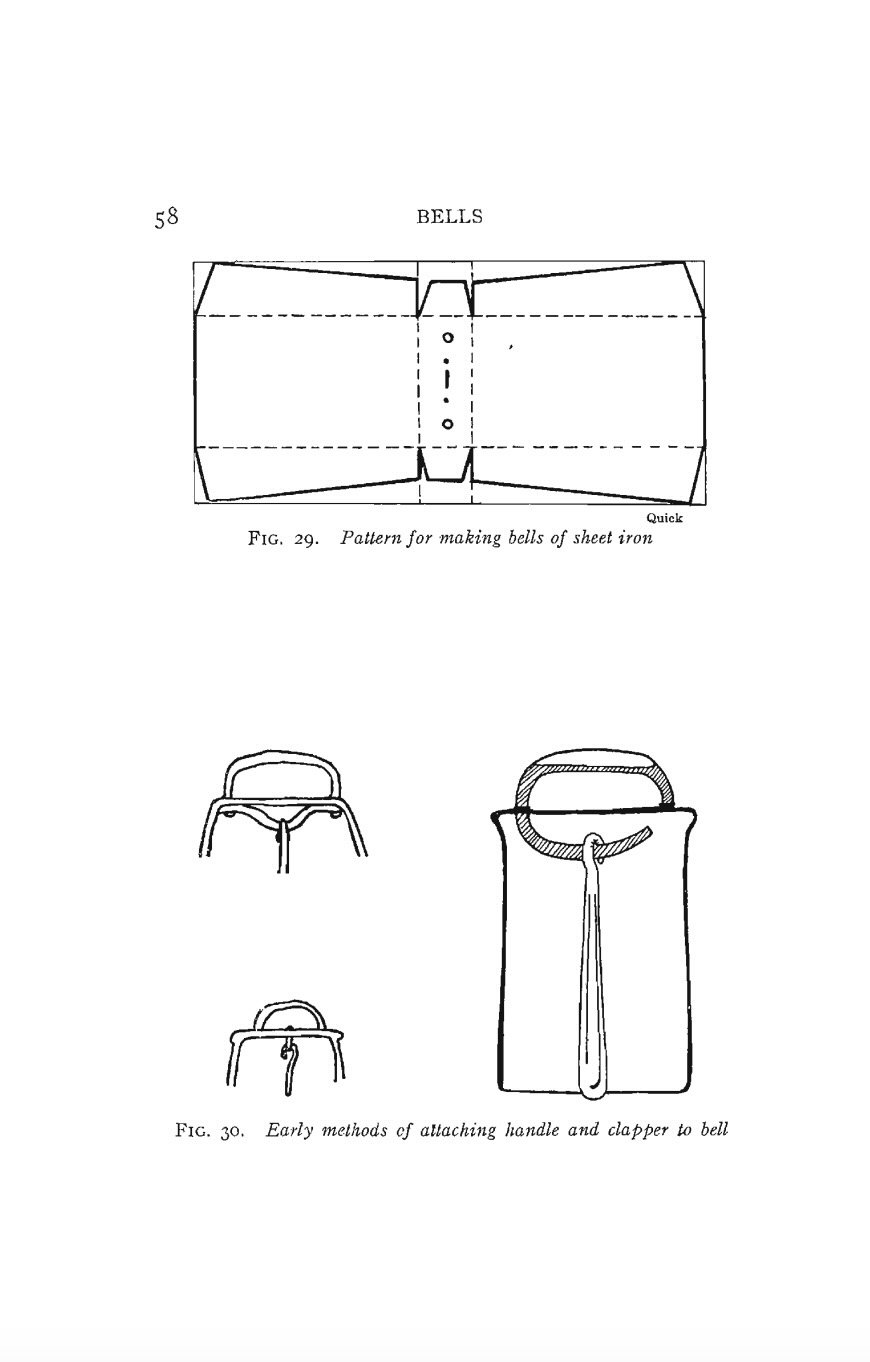
The earliest Christian bells were made from pieces of metal riveted together into a four-sided shape. One of the images above shows a common pattern used to cut sheet iron into a foldable shape. The cut shape was beaten along the lines and bent by hammering. Rivets were added to each side to hold the bell in shape, and a handle with a smooth underside was added to make it comfortable for hand ringing. Finally, a metal loop inside the bell was fixed to attach a clapper. The best bells were then dipped in molten bronze to seal the seams and holes and to make them more solid and resonant. Some of the early bells were rung by being struck with a small hammer, but later bells showed the convenience of adding a clapper. This allowed the bell to be rung with one hand, leaving the other free for other functions.
These so-called Celtic bells were used to summon people to church services and, on occasion, to lead funeral processions, tolling for the dead to the graveyard. The bells were held in such veneration that they were regarded as sacred and preserved with the greatest care. In Ireland, many of these bells were handed down for over a thousand years. It was the custom to place the sacred bells in the guardianship of a family selected for that purpose, and a generous grant of land was made to accompany the trust to support the family. In case of invasion or danger from fire, the first duty of the hereditary custodian of the bell was to ensure that the sacred object was safe.
The early Christians came to regard the sound of bells as symbolic of the voice of God, with many believing that bells could perform miracles and cures, and even that they had the power to travel from one place to another without human help. To swear an oath on a sacred bell, a “bell-oath”, was equivalent to swearing on a holy gospel. A false oath would bring severe punishment on the perjurer. The custodian of the bell would often bring it for solemn oath-taking in legal or community matters. This practice was noted by historians as late as the 12th Century.
Bibliography
Archive, I.S.T. (no date) The Welsh Fairy Book: The Lady of the Lake, Internet Sacred Text Archive. Available at: https://sacred-texts.com/neu/celt/wfb/wfb03.htm (Accessed: 1 April 2026).
Bedworth, C. (2025) ‘Siren Song: History of Mermaids in Art’, 2 October. Available at: https://www.dailyartmagazine.com/mermaids-in-art/ (Accessed: 2 February 2026).
Green, C.R. (no date) ‘A Bibliographic Guide to Welsh Arthurian Literature’.
Leather, E.M. (2018) The Folk-lore of Herefordshire. Logaston Press.
Mermaids (no date) Writing in Margins. Available at: https://writinginmargins.weebly.com/mermaids.html (Accessed: 6 February 2026).
Tate (no date) ‘Mermaid‘, Henri Gaudier-Brzeska, 1913, cast c.1965–6. Available at: https://www.tate.org.uk/art/artworks/gaudier-brzeska-mermaid-t00846 (Accessed: 1 February 2026).
The Little Mermaid: The Question of Endings (no date) Writing in Margins. Available at: http://writinginmargins.weebly.com/1/post/2021/03/the-little-mermaid-the-question-of-endings.html (Accessed: 1 April 2026).
The Whiting Society of Ringers - Coleman - Bells: their History, Legends, Making and Uses (no date). Available at: https://www.whitingsociety.org.uk/old-ringing-books/coleman-bells-history-legends-making-uses.html (Accessed: 2 March 2026).
Water mythology (no date). Available at: https://www.lenntech.com/water-mythology.htm#5 (Accessed: 3 May 2026).