Goddess Presence
A timely lecture by Dr. Rebecca Beattie on Finding the Lost Goddesses. Hosted by Tredwells bookshop.
The opening question, what happened to all the British culture, led into a discussion about the importance of the written word and how the life of the Druids, what they saw and what they held sacred, was lost, because they never wrote anything down.
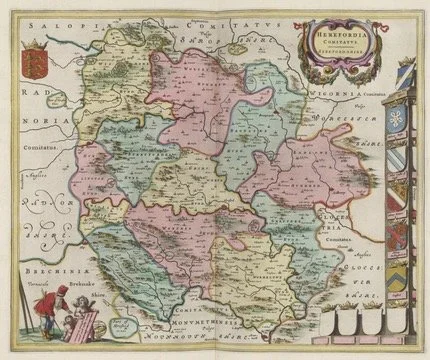
Herefordia Comitatvs 1665|Blaeu, Joan, 1596-1673
There followed a brief history of colonisation by the Romans and the Anglo-Saxons, and of the impact of Viking raids. How sacred sites were appropriated as Christian places of worship, spirits turned into saints, and festivals became religious days.
The erosion of culture saw the old Celtic gods relegated to fairy tales and into children's fiction. But at least the aural tradition of passing stories down through the generations kept the culture alive.
The lost gods, numbering over 300, were originally associated with places, tied to the land, and this is where we look for answers to reclaim them. Look at the land, its artefacts, hills and mounds. Not forgetting bodies of water. Rivers and lakes were particularly holy and sacred because water carries emotional memories, serves as a dwelling for water deities, and forms physical boundaries.
The etymology of place names is also important, with Celtic deities named after features in the landscape. For example, the name of a sacred spring can offer a clue to who was worshipped there. Ask, what are the legends, traditions and folklore of the area? What are the names of the local churches, and who was worshipped there? When the stories are erased, names often remain. If we treat the landscape as an archive, rivers, hills and regions can carry memory far longer than myth. Walking becomes not just a way of remembering, but a way of reconnecting with those lost gods.
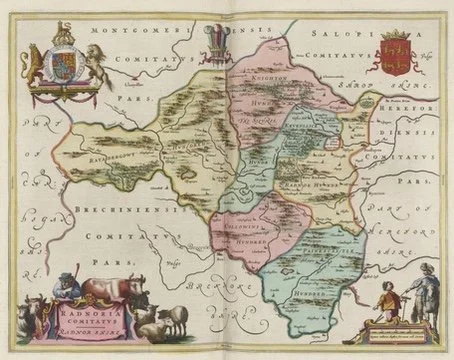
Radnoria Comitatvs
1665|Blaeu, Joan, 1596-1673
Introduction to Elan of the Ways, a contemporary deity recovered by Caroline Wise. Elan emerges as a figure of many facets, an ever-evolving presence who has transformed across centuries, revealing herself through a variety of forms and identities. As Lady Sovereignty, she oversees the land’s energies, guiding rulers and the sacred union that connects people to their land. Her origins stretch back along ancient trackways, echoing the migratory paths of reindeer and elk, and she moves fluidly through vast expanses of time and landscape, adopting masks suited to each era.
Practically, I found myself while walking the woods and paths around the Rodd, I would pay my respects to Elan and ask for her guidance in my searching for meaning within the landscape.
*Referring to the many different belief systems of Ireland, Scotland, Wales, Cornwall and Breton.