Taking in the view
I was surprised by how easy my slow ascent of Wapley Hill felt. The walk had a sense of purpose, bringing with it a deep peace.
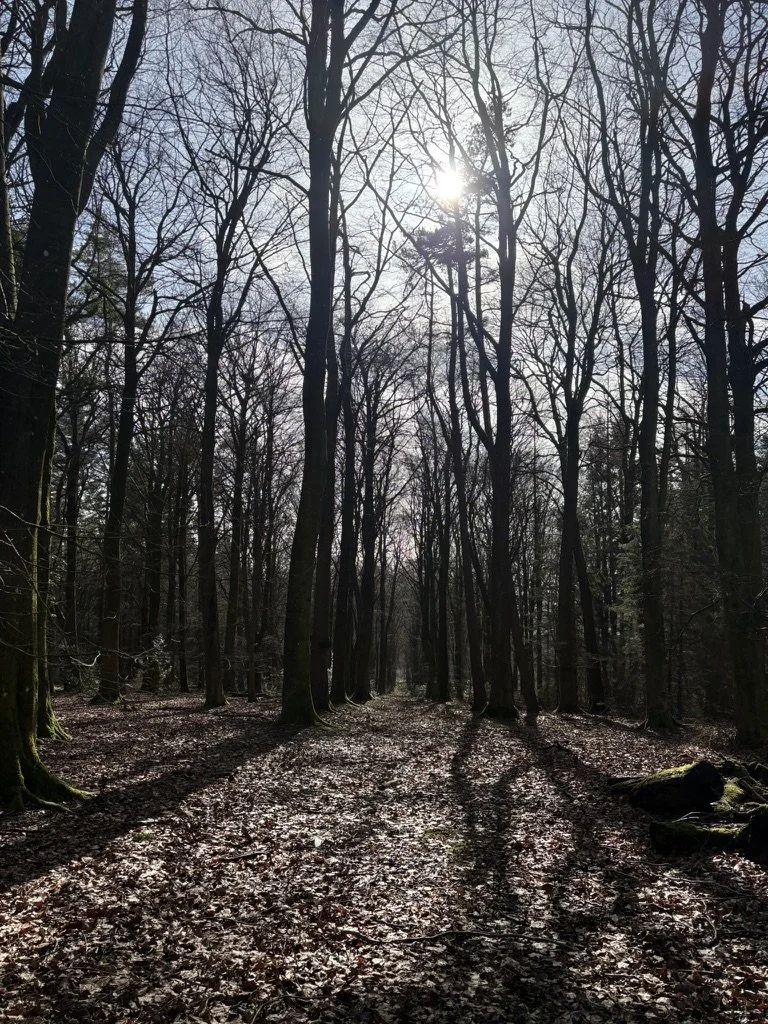
Straight path.
The trees welcomed me, spanning out into an avenue leading up to the top. As I walked, I was aware of everything around me being alive; that ‘more-than-other-in-the-landscape’ phrase came to mind. The agency of nature itself, where elements like plants, rivers, or animals act as active participants rather than passive background scenery. The trees were talking to each other; each held its own voice, the breeze enabling a shared, whispered conversation.
A carved wooden chair.
Thinking about the role of Wapley Hill, it’s obvious that it functions as a viewpoint, a high vantage point, so it's no surprise that it was repurposed by the Romans into a camp.
As I walked around the ‘pillows’ surrounding the camp, I asked questions such as how long it took to build, how many people were involved, and what the initial reason for the structure was. A lifetime of enquiry, I feel!
Walking the pillows.
The precise nature of the feature at Wapley remains a mystery; but the discovery within the enclosure of at least four unexcavated pillow mounds** increases the likelihood that Wapley was at least in part an Iron Age sacred enclosure. Perhaps the elaborate system of ramparts was an attempt to emphasise symbolically the share of the land apportioned by local Celts to their gods.”
From “Prehistoric Sites of Herefordshire” – George Children and George Nash (1994 Logaston Press)